
PHNOM PENH — Acknowledging the growing global trend toward sustainable travel, public and private stakeholders in tourism have pledged to transform the country’s sector into a decarbonized one through environmentally-responsible practices.
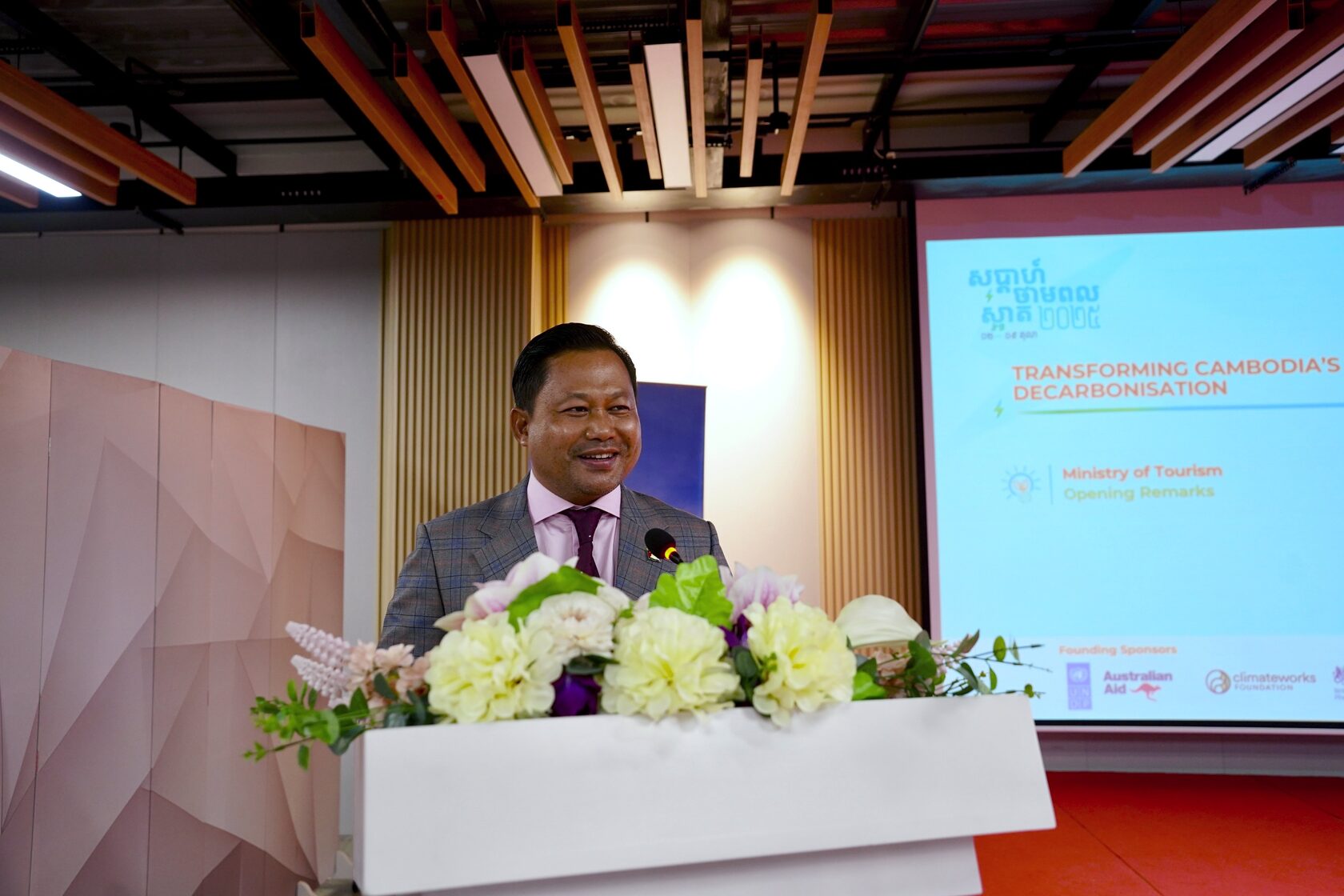
Held as part of the Clean Energy Week events, the session on “Transforming Cambodia’s Tourism Through Decarbonization” focused on the progress made to integrate clean-energy practices in the tourism sector, with speakers and participants recommending practical approaches to advance decarbonized tourism in the country.
Kuch Pannhasa, secretary of state of the Ministry of Tourism, noted that climate change poses a significant threat to natural resources and the livelihoods of people in the country who depend on the tourism industry to support themselves, emphasizing the urgent need to embrace decarbonization in the sector.
“Decarbonization is no longer a distant dream: It is a reality we are actively building,” he said. “From reducing carbon emissions in hotel transport to promoting eco-tourism and supporting local communities, we aim to position the country as a leader in sustainable tourism.
“Cooperation with local communities and international partners is vital,” Pannhasa added. “By investing in renewable energy, energy efficiency and education programs for tourism workers, we not only reduce our carbon footprint but also drive innovation and change.”
Frantz Vaganay, managing partner of Sevea Consulting Cambodia, acknowledged the crucial role of the government in shaping the country’s sustainable tourism industry, noting that numerous strategies and policies are already in place.
“At the national level, Cambodia has set long-term carbon neutrality goals, aiming for net-zero emissions by 2050,” Vaganay said. “The recently submitted Nationally Determined Contribution (NDC) 3.0 raises the ambition to achieve up to 55 percent emission reduction by 2035, making Cambodia one of the first countries to submit such an updated plan.”
Ministries have developed ambitious strategies and roadmaps for sustainable development at the national level, which is a major step forward, Vaganay said, noting that effectively implementing them will take efforts and coordination on their part.
Soeung Sarouen, executive director of the NGO Forum, whose projects also include a campaign to promote fossil-fuel-free tourism, said there will be numerous practical policy needs to be integrated within ministries in order to transform the nation into a fossil-fuel free tourism zone as tourism involves many elements of the country ranging from agriculture and the environment to natural ressoures and infrastructure.
Moreover, Sarouen said, incentive policies supporting low-cost energy and energy transition—such as solar panels on rooftops for restaurants, hotels or food processing facilities—could be considered.
Hotels and Communities Advance Low-Carbon Tourism Practices
Beyond the public sector, some people in the private sector such as NGOs, hotels and tour operators are also working for a low-carbon or cleaner energy tourism. And some tourists respond to these efforts.
Chhun Lida, sustainability manager at Six Senses Krabey Island in Sihanoukville, said that hotels that prioritize sustainability and eco-friendly practices are favored by some travel agencies and guests.
“Decarbonization is no longer optional: It is now a required standard,” Lida said. “Travel agencies now check whether hotels have decarbonization programs, energy and water monitoring or waste separation.
“Guests also pay attention to renewable energy use and sustainability practices,” Lida said. “At Six Senses Krabey Island, guest feedback includes sustainability, and the hotel offers an Earth Lab program where visitors can learn about sustainable lifestyles, workshops, and recycling.”
Anna Pawlik-Szocs, general manager and sustainability advisor at Canvas & Orchids Retreat along the Tatai River in Koh Kong province, said the eco-lodge focuses on guests looking for sustainable travel experiences.
“At Canvas, we do not target any travelers; rather, we target potential guests who travel responsibly,” Pawlik-Szocs said. “Additionally, we suggest public transportation like buses instead of private taxis.
“We even get questions about train accessibility to Koh Kong; however, building a railway would require deforestation, so it is not planned,” Pawlik-Szocs added.
Nev Broadis, CEO of Sam Veasna Conservation Stay and senior technical advisor to the Wildlife Conservation Society (WCS), said that the NGO is actively engaged in encouraging local residents to embrace ecotourism instead of deforestation.
As a technical partner with the Ministry of Environment in implementing the programs Reducing Emissions from Deforestation and Forest Degradation (REDD+) in Mondulkiri and Preah Vihear provinces, Broadis said that WCS also helps to support ecotourism initiatives in communities.
“We work with local communities to showcase natural features such as waterfalls or ancient forests,” Broadis said.“REDD+ provides funding, giving locals a sustainable source of income and reducing the need for deforestation.”
-----
Article by: https://cambodianess.com
Held as part of the Clean Energy Week events, the session on “Transforming Cambodia’s Tourism Through Decarbonization” focused on the progress made to integrate clean-energy practices in the tourism sector, with speakers and participants recommending practical approaches to advance decarbonized tourism in the country.
Kuch Pannhasa, secretary of state of the Ministry of Tourism, noted that climate change poses a significant threat to natural resources and the livelihoods of people in the country who depend on the tourism industry to support themselves, emphasizing the urgent need to embrace decarbonization in the sector.
“Decarbonization is no longer a distant dream: It is a reality we are actively building,” he said. “From reducing carbon emissions in hotel transport to promoting eco-tourism and supporting local communities, we aim to position the country as a leader in sustainable tourism.
“Cooperation with local communities and international partners is vital,” Pannhasa added. “By investing in renewable energy, energy efficiency and education programs for tourism workers, we not only reduce our carbon footprint but also drive innovation and change.”
Frantz Vaganay, managing partner of Sevea Consulting Cambodia, acknowledged the crucial role of the government in shaping the country’s sustainable tourism industry, noting that numerous strategies and policies are already in place.
“At the national level, Cambodia has set long-term carbon neutrality goals, aiming for net-zero emissions by 2050,” Vaganay said. “The recently submitted Nationally Determined Contribution (NDC) 3.0 raises the ambition to achieve up to 55 percent emission reduction by 2035, making Cambodia one of the first countries to submit such an updated plan.”
Ministries have developed ambitious strategies and roadmaps for sustainable development at the national level, which is a major step forward, Vaganay said, noting that effectively implementing them will take efforts and coordination on their part.
Soeung Sarouen, executive director of the NGO Forum, whose projects also include a campaign to promote fossil-fuel-free tourism, said there will be numerous practical policy needs to be integrated within ministries in order to transform the nation into a fossil-fuel free tourism zone as tourism involves many elements of the country ranging from agriculture and the environment to natural ressoures and infrastructure.
Moreover, Sarouen said, incentive policies supporting low-cost energy and energy transition—such as solar panels on rooftops for restaurants, hotels or food processing facilities—could be considered.
Hotels and Communities Advance Low-Carbon Tourism Practices
Beyond the public sector, some people in the private sector such as NGOs, hotels and tour operators are also working for a low-carbon or cleaner energy tourism. And some tourists respond to these efforts.
Chhun Lida, sustainability manager at Six Senses Krabey Island in Sihanoukville, said that hotels that prioritize sustainability and eco-friendly practices are favored by some travel agencies and guests.
“Decarbonization is no longer optional: It is now a required standard,” Lida said. “Travel agencies now check whether hotels have decarbonization programs, energy and water monitoring or waste separation.
“Guests also pay attention to renewable energy use and sustainability practices,” Lida said. “At Six Senses Krabey Island, guest feedback includes sustainability, and the hotel offers an Earth Lab program where visitors can learn about sustainable lifestyles, workshops, and recycling.”
Anna Pawlik-Szocs, general manager and sustainability advisor at Canvas & Orchids Retreat along the Tatai River in Koh Kong province, said the eco-lodge focuses on guests looking for sustainable travel experiences.
“At Canvas, we do not target any travelers; rather, we target potential guests who travel responsibly,” Pawlik-Szocs said. “Additionally, we suggest public transportation like buses instead of private taxis.
“We even get questions about train accessibility to Koh Kong; however, building a railway would require deforestation, so it is not planned,” Pawlik-Szocs added.
Nev Broadis, CEO of Sam Veasna Conservation Stay and senior technical advisor to the Wildlife Conservation Society (WCS), said that the NGO is actively engaged in encouraging local residents to embrace ecotourism instead of deforestation.
As a technical partner with the Ministry of Environment in implementing the programs Reducing Emissions from Deforestation and Forest Degradation (REDD+) in Mondulkiri and Preah Vihear provinces, Broadis said that WCS also helps to support ecotourism initiatives in communities.
“We work with local communities to showcase natural features such as waterfalls or ancient forests,” Broadis said.“REDD+ provides funding, giving locals a sustainable source of income and reducing the need for deforestation.”
-----
Article by: https://cambodianess.com