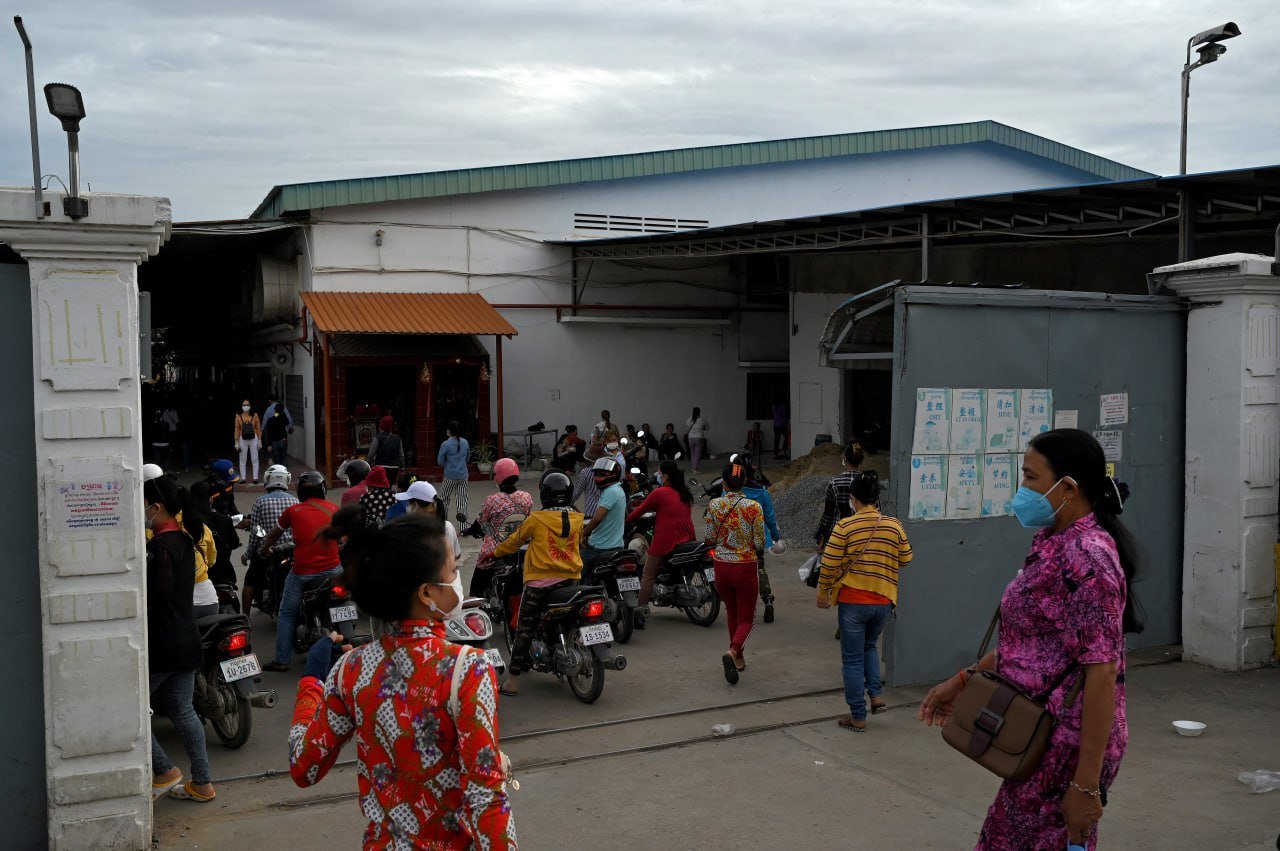
PHNOM PENH — Experts highlight that high electricity costs and a lack of financial resources for renewable energy are currently pressing challenges for the garment sector to decarbonize in Cambodia and align with global sustainability standards. But despite these challenges, they express optimism about a greener future through collaboration and a stronger energy policy.
According to Peter Ford, energy policy lead for garment and clean energy skills at Energy Lab, global brands aim for 50 percent carbon reduction by 2030 and net zero by 2050. Many brands sourcing from Cambodia, including major ones such as Nike, Inc. and Adidas AG, are converting to electric boilers.
Net-zero commitments for brands mean that all energy consumed must be renewable electricity, with discussions on adding emission factors to biomass, Ford said. “There are challenges in Cambodia,” he said. “Currently, factories cannot demonstrate the use of renewable electricity. They cannot benefit from this low vision factor. Created biomass that is used in the factories is often from problematic sources.
“There is a direct link to deforestation and forest wood in Cambodia, and this is one of the strongest reasons for brands and factories to be looking at electrification and removing the need for biomass at all,” he said.
The report from Energy Lab reads that 800 factories consume 8 percent of Cambodia's electricity, which is about 50 percent of their total energy needs. This costs them $350 million annually.
If they replace all biomass with electric boilers, their energy consumption would rise by about 13 percent of total electricity, which would increase their annual bill to $650 million, the report states.
Ford added that rooftop solar legislation in Cambodia needs improvement to make it easier and cheaper for factories to install.
Saron Sovichea, STAR Network Secretariat head, said that renewable energy is facing significant challenges in developing countries due to high costs, financing difficulties and policy uncertainty.
Interest rates are unfavorable and solar energy investments entail long payback periods, complicating financial decisions amid market volatility, he said, pointing out that countries like Vietnam and Bangladesh have experimented with policies such as net metering, which have required adjustments over time, creating unpredictability for investors.
Moreover, there is a need for awareness and capacity building among lenders and manufacturers to facilitate a successful transition, Sovichea said. “Despite these obstacles, renewable energy is increasingly seen as a key performance indicator and a business opportunity, particularly in Cambodia where there is potential for growth in this sector,” he said.
Ly Tekheng, assistant to Secretary General of the Textile, Apparel, Footwear & Travel Goods Association in Cambodia (TAFTAC), said that the high cost of electricity in Cambodia remains a challenge while there is a need for the government to support making electricity cheaper and more accessible for factories.
“Comparing Cambodia to Vietnam, to the neighboring country, I think we have a real issue with this electricity cost,” he said. “We have 900 factories that are our members. We are trying to get the electricity cheaper, or finding those technologies that can help with that.”
But There's Still a Way
Um Serivuth, technical expert at the Ministry of Industry, Science, Technology & Innovation, said that the government has been promoting green energy, and as such, the ministry has set the target of achieving 70 percent of the renewable energy projects.
He praised the efforts of the projects of the United Nations Development Programme (UNDP), the Asian Development Bank (ADB) and the World Bank to support the implementation of the national energy efficiency policy.
“This is where the government can help with the private sectors, and this is a good opportunity as well for the private sector to be involved to influence energy efficiency,” Serivuth said.
Ly Tekheng of TAFTAC urged the Cambodian government to streamline policies to make electricity cheaper and more accessible for factories. “We are investing in our environment,” he said. “The government should build a friendly policy that enables factories to make it very simple to install solar, for instance, without burden from the government, without charge from the government.”
Saron Sovichea of the STAR Network said that establishing renewable energy certificates and power purchase agreements are foundational steps to support the transition to renewable energy. “My mandate is to speak regionally, and I try not to be biased towards any one country,” he said. “We should really be foundationally prepared for this. There are going to be many more roadblocks ahead.”
Peter Ford of Energy Lab said that energy certificates should be available in Cambodia to help brands understand factory energy use, while the country should improve rooftop solar access and corporate power purchase agreements.
“Currently, none of them are available in Cambodia, so improved rooftop solar access for factories and then, ideally and the ultimate option, would be corporate power purchase agreements,” he said. “This allows factories to contract for renewable energy directly through the grid. There is no room for error.”
Ford added that other major garment countries such as Vietnam, Bangladesh, India, Turkey and China have implemented these options, making Cambodia an outlier.
-----
Article by: https://cambodianess.com
According to Peter Ford, energy policy lead for garment and clean energy skills at Energy Lab, global brands aim for 50 percent carbon reduction by 2030 and net zero by 2050. Many brands sourcing from Cambodia, including major ones such as Nike, Inc. and Adidas AG, are converting to electric boilers.
Net-zero commitments for brands mean that all energy consumed must be renewable electricity, with discussions on adding emission factors to biomass, Ford said. “There are challenges in Cambodia,” he said. “Currently, factories cannot demonstrate the use of renewable electricity. They cannot benefit from this low vision factor. Created biomass that is used in the factories is often from problematic sources.
“There is a direct link to deforestation and forest wood in Cambodia, and this is one of the strongest reasons for brands and factories to be looking at electrification and removing the need for biomass at all,” he said.
The report from Energy Lab reads that 800 factories consume 8 percent of Cambodia's electricity, which is about 50 percent of their total energy needs. This costs them $350 million annually.
If they replace all biomass with electric boilers, their energy consumption would rise by about 13 percent of total electricity, which would increase their annual bill to $650 million, the report states.
Ford added that rooftop solar legislation in Cambodia needs improvement to make it easier and cheaper for factories to install.
Saron Sovichea, STAR Network Secretariat head, said that renewable energy is facing significant challenges in developing countries due to high costs, financing difficulties and policy uncertainty.
Interest rates are unfavorable and solar energy investments entail long payback periods, complicating financial decisions amid market volatility, he said, pointing out that countries like Vietnam and Bangladesh have experimented with policies such as net metering, which have required adjustments over time, creating unpredictability for investors.
Moreover, there is a need for awareness and capacity building among lenders and manufacturers to facilitate a successful transition, Sovichea said. “Despite these obstacles, renewable energy is increasingly seen as a key performance indicator and a business opportunity, particularly in Cambodia where there is potential for growth in this sector,” he said.
Ly Tekheng, assistant to Secretary General of the Textile, Apparel, Footwear & Travel Goods Association in Cambodia (TAFTAC), said that the high cost of electricity in Cambodia remains a challenge while there is a need for the government to support making electricity cheaper and more accessible for factories.
“Comparing Cambodia to Vietnam, to the neighboring country, I think we have a real issue with this electricity cost,” he said. “We have 900 factories that are our members. We are trying to get the electricity cheaper, or finding those technologies that can help with that.”
But There's Still a Way
Um Serivuth, technical expert at the Ministry of Industry, Science, Technology & Innovation, said that the government has been promoting green energy, and as such, the ministry has set the target of achieving 70 percent of the renewable energy projects.
He praised the efforts of the projects of the United Nations Development Programme (UNDP), the Asian Development Bank (ADB) and the World Bank to support the implementation of the national energy efficiency policy.
“This is where the government can help with the private sectors, and this is a good opportunity as well for the private sector to be involved to influence energy efficiency,” Serivuth said.
Ly Tekheng of TAFTAC urged the Cambodian government to streamline policies to make electricity cheaper and more accessible for factories. “We are investing in our environment,” he said. “The government should build a friendly policy that enables factories to make it very simple to install solar, for instance, without burden from the government, without charge from the government.”
Saron Sovichea of the STAR Network said that establishing renewable energy certificates and power purchase agreements are foundational steps to support the transition to renewable energy. “My mandate is to speak regionally, and I try not to be biased towards any one country,” he said. “We should really be foundationally prepared for this. There are going to be many more roadblocks ahead.”
Peter Ford of Energy Lab said that energy certificates should be available in Cambodia to help brands understand factory energy use, while the country should improve rooftop solar access and corporate power purchase agreements.
“Currently, none of them are available in Cambodia, so improved rooftop solar access for factories and then, ideally and the ultimate option, would be corporate power purchase agreements,” he said. “This allows factories to contract for renewable energy directly through the grid. There is no room for error.”
Ford added that other major garment countries such as Vietnam, Bangladesh, India, Turkey and China have implemented these options, making Cambodia an outlier.
-----
Article by: https://cambodianess.com